
Buy AutoTrafficRSS script now for $27 only!
We will send the script to your PayPal email within few hours,Please add FullContentRSS@gmail.com to your email contact.Source: How to Get Your Content in the #Google #SERP's Featured Snippet
Buy AutoTrafficRSS script now for $27 only!
We will send the script to your PayPal email within few hours,Please add FullContentRSS@gmail.com to your email contact.
Buy AutoTrafficRSS script now for $27 only!
We will send the script to your PayPal email within few hours,Please add FullContentRSS@gmail.com to your email contact.As the world welcomes the New Year and still plans for new resolutions, Google seems to be ready with its upgrades and strategies already. All the Search Engine Optimization practitioners out there need to upgrade their plans now. In 2017, the new word for SEO is 'Trust.' Yes! With Google focusing on relevancy-oriented search, trust is at the core of this approach without which, one is just not 'relevant.'
What's the challenge?
Well, the challenge is regarding visibility and trust, especially for those who are new. To garner trust, enhancing your visibility is the first thing you have to do. Think it simple: out of the billion posts in Google, if a reader doesn't find you in the first place, expecting him or her to share your post is futile, isn't it?
There's a solution!
We have a solution, relax! SEO is the key here. As long as we adhere to Google's rules, we can certainly expand our reach and gain profitability in this more competitive 2017. However, before jumping on to the latest SEO strategies, let's check out the updates first.
The core aim of the search engine giant is to give the most relevant search results in the fastest possible time. Again, there have been updates in Google's many algorithms, and it seems there is no stopping to Panda, Penguin and Hummingbird updates. The motive is to eradicate scams and boost user experience to the highest level.
Google's new strategies are going to keep business owners on their toes for sure, as consumers today are smarter and know exactly what they require. Let's have a look at the 6 major strategies to win over SEO in 2017.
6 smart and strong SEO strategies for 2017
1. "Loading…"Google is certainly not a place to test patience; the company is more concerned about user's experience. So, first thing – increase your website's page loading speed.
Strategy?
Varvy Page Speed tool, GTMetrix, Google's Page Speed, are some of the tools that you can use.
2. Content marketing: Content is still on the throne!
In 2017, you just have to push up this factor. As Google says, "Create tremendously high-valued contents that will work as anchors for your website."
So, focus on content marketing. The search engine recommends high trafficked sites like LinkedIn, Quora, WiseLike, etc. for content marketing that would drastically push you up the SERP.
Strategy?
Recommended for You
Webcast, January 24th: The Science of Attention and Growth Marketing
3. Google – towards a mobile-only strategyBy now, you must have noticed that Google is gradually moving towards mobile only world. With their research showing a drastic rise in mobile searches, you need to optimize your website accordingly to be in pace with their changed focus.
Strategy?
4. Engage more; socialize more
The next thing this search engine giant wants you to learn is – to engage more and be social. You need to build your reputation more strategically.
Strategy?
5. Videos – they cast that SEO magic
Who doesn't know the popularity of YouTube! This proves clearly that video marketing can boost a content and hence, a website to a much higher level.
Strategy?
6. Voice search
While this has already gained some popularity, 2017 is expecting to go beyond recognition of voice. As per data, around 56% of adults say, they enjoy voice search. And 55% of teenagers use this technology regularly.
Strategy?
SEO practitioners should not limit themselves to just text-based queries. Rather, they must scrutinize voice innovation and make necessary changes.
3 major pillars to dominate SERP in 2017
Apart from the above-mentioned strategies, there are three other factors (considered as the 'pillars of trust') that are integral to Google's relevancy-oriented approach.
1st – Authority :
If you can link your site to those that are high profile, your website will be more trusted by Google.
2nd – Age :
This refers to the moment when Google has recognized your domain, i.e. the index age. Well, no shortcuts; you actually have to do some activity in your domain after purchasing it. Only then will Google notice you.
3rd – Content :
The readers are far away from these SEO, algorithm and such stuff. They are in the lookout for valuable contents. Create more of such contents.
Well, from all these above, we can conclude that 2017 would be big for us. To take on future challenges, be ready with these upcoming trends.

Buy AutoTrafficRSS script now for $27 only!
We will send the script to your PayPal email within few hours,Please add FullContentRSS@gmail.com to your email contact.A common challenge when doing SEO for e-commerce sites is deciding how to choose keywords for product pages. When it comes to e-commerce in particular, there's always that question on a page-by-page basis of "Which keyword is right for this page?" Especially for existing sites that need an SEO update, finding time to do page-specific keyword research can be burdensome. But product pages deserve every ounce of SEO they can get. Today, I'll show you a way to make your e-commerce product page keyword research a lot easier.
My secret weapon?
MozBar.
By the end of this post, you'll discover how you can easily:
Let me show you how.
What makes a good SEO e-commerce keyword?Since e-commerce pages often have direct competition from other websites, you need to go above and beyond when it comes to optimization. You'll want to make sure you take into consideration not only the search intent of your desired customer, but also verify that the keyword you choose is actually delivering similar results in the SERP. When people search for products, you want to measure how narrow you have to go before a search result page starts displaying products similar to what you have.
For this example, I'll use an e-commerce site that sells macbook and car decals. Think of all the different variants of those two broad search terms. There are 12 different subcategories of car decals alone.
One category is family decals, which allows a person to pick and choose amongst individual icons to create a customized family to display on the back of your minivan.

For this family decal segment, there are dozens of different individual product pages, so the goal is to make sure we optimize not just for a broad term like "car decal" but for a more nuanced term like "family car decal." And then for the products themselves, dig into modifying terms relevant to the features.
Use MozBar to save time researching SEO e-commerce keywordsA common way to figure out what's showing up for a search term is to just run a search query. But when you have thousands of pages, this can take forever.
This is where the MozBar Page Optimization feature really helps you get the job done. It allows you to stay on the website to do analysis without jumping between tabs to run search queries.
Let's go through the steps.
1. First, of course, download the MozBar extension for Google Chrome (I'll wait).
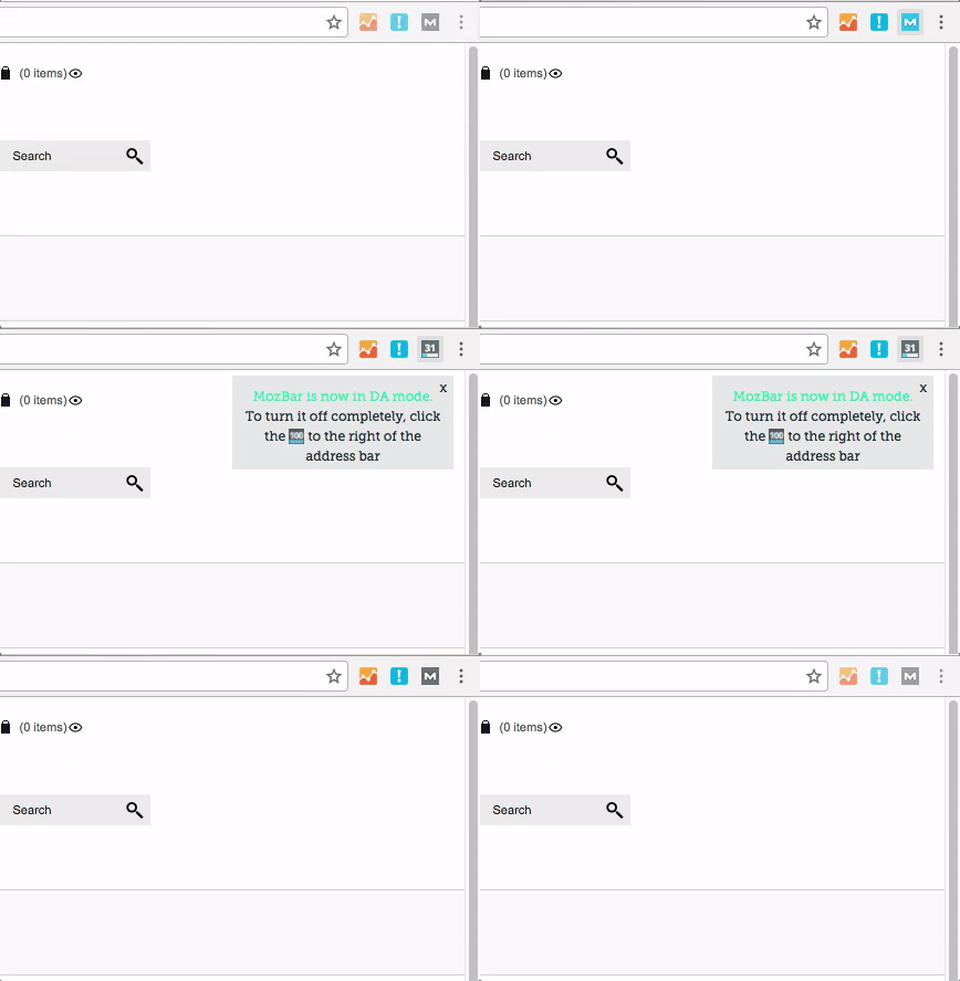
2. Next, go to your product page and activate your MozBar extension by selecting the icon until it turns blue (there are three statuses, FYI — on, DA mode, and off).
3. Then, select the Page Optimization icon near the top-left of your browser window. The icon looks like a little page with a circle in the corner:

4. A small text box window will appear. You'll want to have a list of terms ready to go, so if you haven't done your keyword research yet, head over to Keyword Explorer and use the "Suggestions" tool to get some preliminary ideas. I usually enter a broad category-level keyword, then select "Optimize":

In addition to all the normal great stuff that MozBar provides, such as Domain Authority and Page Authority, the Page Optimization tool also gives you a quick overview of how well this individual page is optimized for the term you're researching. This is similar to the information you'd get in the Moz Pro Campaign tools, but here you can see it for any page without having to have Moz open in another tab.
5. Once you've entered your search term, select the "On-Page Content Suggestions" tab:

The On-Page Content Suggestions tab shows you a list of keywords that the search engines typically associate with the term you entered. Think of this as other planets in the same constellation as the keyword you entered. You can use these generally to understand what additional words to put on your page, but you can also use them to identify the target keyword for the page overall.
Here's where this gets awesome. Prepare to shave minutes off of your normal workflow.
Aligning search intent with e-commerce keywordsStarting with your highest-value products, navigate to the product page, open up MozBar, enter in your broad target keyword for the associated category, and then select the On-Page Content Suggestions tab.
Then, look for the keywords from the list that appear most aligned with your specific product. In this example, we're looking at a family car decal product that exists in a broader category of car decals.
The question to ask is: Which keyword displays products that are most similar to your product?
If you can find results that align closely with your product, then you can understand something about how search engines are interpreting the term and have a higher chance of optimizing for the right keywords.
To see which pages are ranking for a given suggested keyword, simply select the "See top ranking URLs" dropdown. It will display the URL and rank position of sites delivering content similar to your initial target search term:

Using this example, you can interpret that "family stickers" definitely delivers results closely aligned with this product. Note that this correlates to the blue "Relevance" bar associated with that suggested keyword.
Make a note of the terms that are providing highly aligned search results pages, and then move onto the next product page. Once you have your list compiled, you'll be able to be more selective and informed with your page optimization choices.
I hope you find this e-commerce keyword trick helpful. Let me know in the comments section of this article!
Bonus tip for making your life easy:When doing this kind of research, I recommend saving yourself some time down the road by copying the URLs that show up in the On-Page Content Suggestions tab into a new spreadsheet or document. You can compile and research these URLs later using Open Site Explorer.
When it comes time to think about building links to my optimized pages, you'll have a ready list of competitors to analyze. Look at their Inbound Links, Top Pages, and Anchor Text in Open Site Explorer in order to create a list of potential linking sites and content ideas.
Get started with MozBar for Chrome
If you're interested in more keyword research strategies, consider signing up for a Keyword Research Workshop in the Moz Training site. For a deeper dive on MozBar, sign up for our January 24 webinar!
Optimizing your ecommerce site for better rankings should be a top priority for any growth-focused business owner.
Being on the first page is no longer enough to generate enough traffic, CTR, and sales, for 2016 and 2017, the main goal should be to rank 1 and I will tell you why.
In 2011, a research conducted by Optify and published by Search Engine Watch showed that "websites ranked number one received an average click-through rate (CTR) of 36.4 percent; number two had a CTR of 12.5 percent; and number three had a CTR of 9.5 percent."
This report illustrates vividly the value of holding the number 1 spot in search results.
In the article below, I will be sharing five proven SEO strategies for retailers to rank their ecommerce sites in 2017.
1) Use LSIsAmong the best practices for SEO in 2016 and 2017 is the use of Latent Semantic Indexing (LSI) keywords. LSI's keywords are phrases or words closely related to the main keyword or phrase of your page or content.
Adding these keywords to your web pages will improve your SEO for a variety of search terms. Bear in mind, visitors will always use different or a combination of terms in search engines but optimizing your web page with LSI's allows you to rank easily for closely related keywords.
For example, when optimizing a coupon website for keywords, LSI's such as promotion codes, discount codes, discounts and deals can be sprinkled over the content in your coupon offers or category description.
Finally, there won't be a need for LSI's on a squeeze page with no content but for product description and large e-commerce stores like Amazon, LSI's will surely get on the good side of search engines.
2) Write Long Descriptions For Products and Pages (1000+) and Sprinkle Keyword 3 – 5xAccording to SERP data from SEMRush, longer content tends to rank best in Google. This is because search engines (Google) wants visitors to understand the value on your page, more content on your web pages allows search engines to crawl and provide value to web users.
I understand it is impossible to write up to or more than 1000 words for every page on your e-commerce site (don't sweat it) simply write in-depth 100 words for products or category pages.
After writing your in-depth descriptions, include your main keyword at least 3 times in your descriptions. Doing this, give signals to search engines as to what the page is about.
For example, if your web page is about "Winter Skips" then you need to include that exact phrase at least 3 times in the fully written description.
Avoid poorly written or duplicate product descriptions (many retailers are guilty of this crime), hyperlink properly to internal pages or related items.
3) Use Neuromarketing Hacks To Maximize Page CTRThere is no point stressing out the need to include your main keyword in your page's title tag. But do you know adding a prefix before your main keyword can actually skyrocket your CTR from search results?
Prefixes or Click Magnets such as "Cheap", "Buy" and "30% Off" can increase your CTR and help you show up for long tail search queries. It is advisable to use prefixes for every product page as visitors punch in more precise queries such as "cheap winter skips" or "Nordstrom deals".
Bear in mind, Google presumably uses organic CTR as a ranking signal according to Paul Haahr, well if they don't, more click-throughs = more sales so you don't lose in any way.
For example, almost every page with title tags on ChameleonJohn contains click magnets such as "30% off", "Free Shipping" or "Up to 60% off" which generate more clicks (since we all like discounts).
For optimal results, include creative (and appropriate) click magnets into your title tags and descriptions tags and put longer phrases in description tags since you have more room for words to gain more clicks and sales.
4) Use Date Modifiers For CouponsFor businesses in the coupon industry, best practice will be to include date modifiers (2016, 2017) on each coupon page to show visitors that the coupons are fresh. For example, Kohl's coupon page shows the last updated date including an expiry date for each coupon offer.
This allows search engines to crawl in-depth, provide comprehensive search results and rich snippets for visitors.
5) Implement Product Review Schema by Displaying Rich Snippets in GoogleRich snippets were first launched in 2009, they offer a way of adding more information to a search listing which could be in form of a star rating of a review or price of an item.
Webmasters can markup web pages with Schema.org making ecommerce sites eligible for displaying rich snippets in search results. Using structured data markup allows search engines to crawl and display page content comprehensively even though Google does not guarantee rich snippets for every website.
For clarification purposes, rich snippets do not affect site rankings but the use allows for comprehensive search listings for visitors, an increased CTR and indirect SEO benefits such as easily indexable web pages and detailed metadata.
Laurynas Skupas is the co-founder and CEO of ChameleonJohn
Want to stay on top of the latest search trends? Get top insights and news from our search experts.
Related readingEveryone who knows me knows I'm obsessed with unicorns – not just the magical beasts you'll often find hanging out near rainbows but marketing unicorns.
A new, free search engine called Semantic Scholar is using AI technology to help these scientists find relevant information much more quickly.
It's the right time of the year to evaluate your SEO strategy and examine the best ways to improve it during 2017. This doesn't have to be a complicated process, though.
Understand how predict what ROI will be achieved as a result of implementing an SEO fix.

Buy AutoTrafficRSS script now for $27 only!
We will send the script to your PayPal email within few hours,Please add FullContentRSS@gmail.com to your email contact.


