
Tuesday, August 23, 2016

Off Page SEO: Beyond Link Building

Off Page SEO: Beyond Link Building

This article is part of an SEO series from WooRank. Thank you for supporting the partners who make SitePoint possible.

When the topic of off page SEO comes up, more often than not people are talking about link building. And with good reason. Building a backlink profile of quality links is one of the most important parts of SEO. However, off page SEO is more than just link building. There are several optimizations that take place off-page that contribute to your site's trust, authority and ranking in search results, as well as driving traffic.

In this piece we'll go over a few ways you can shape your site's off page factors to manage its appearance in search results, and ultimately increase its rank — all without building a single new link.

Google Knowledge Graph

The Knowledge graph is Google's attempt to enhance search results using semantic search information gathered from the web. In other words, it's Google's way of figuring out what you're searching for and providing that information directly in its SERP. For branded keywords, the Knowledge Graph is like a giant billboard in Google's search results. Getting your business or personal brand to appear in the Knowledge Graph is a way to jump right to the front page.
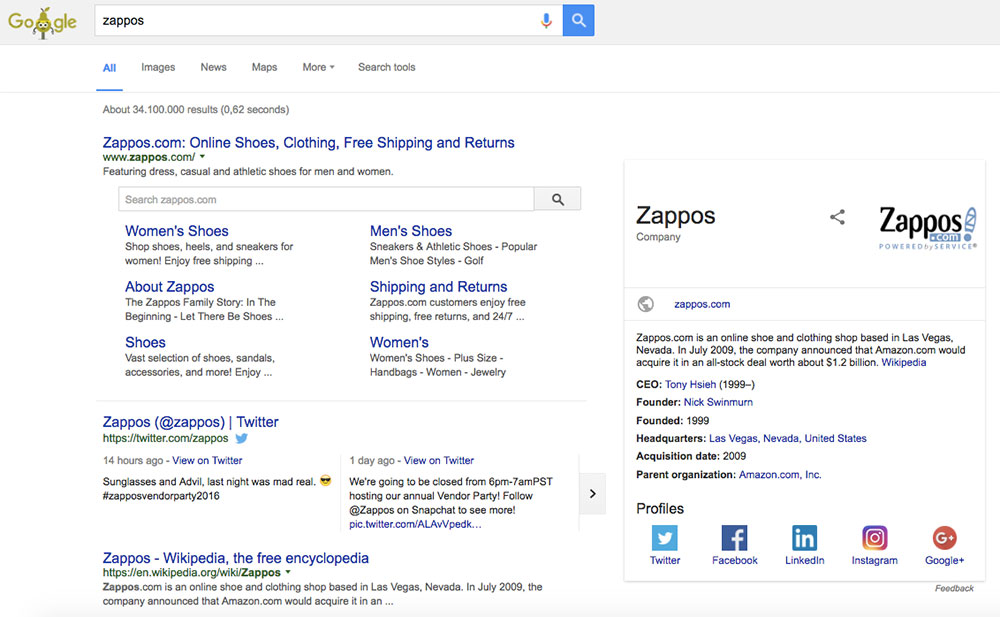
Zappos Knowledge Graph

Some marketers dislike the Knowledge Graph because it sometimes links to other people's content and can lead to searchers bypassing your site, but it appears for branded keywords whether you want it to or not. In this case you can't beat them, so you may as well join them. Plus, in the end, if you do a good job optimizing your off page SEO, the benefits will outweigh the disadvantages.

So how do you make sure the Knowledge Graph for your brand is being displayed, and how do you optimize your content for it?

Google+

The first step is to create a Google+ page for your business and pick a business type that best suits yours. When you create your page, use the brand name that people use when searching for you. So, for example, Recreational Equipment, Inc. would use the name REI when creating its Google+ page. If you aren't sure, check in Google Search Console or Analytics reporting to see which keywords generate the most impressions.

The stronger your Google+ presence, the more likely it is that Google with serve a Knowledge Graph rich snippet and include your feed in it. Keep your profile active by posting regularly and periodically run campaigns to generate +1s on your content. This will have the added benefit of telling Google what your brand is about, which will help to optimize the content in the rich snippet.

Wikipedia

Wikipedia and Wikidata are probably the two most important non-Google sources for Knowledge Graphs, especially since Google migrated from Freebase. Google relies heavily on the data from Wikipedia to populate certain parts of the Knowledge Graph such as company type, description and details. Being listed on the Wikipedia family of sites, particularly the two mentioned above, gives Google a strong hint to show this information in a Knowledge Graph when a user searches for your brand.

If your company or personal brand doesn't already have an entry on Wikidata, create one now. Include the following information:

  • Label: This is your brand's name (or your name if it's a personal brand). Like your Google+ page, use the name people search for.
  • Description: Small bits of information used to differentiate items with identical or very similar labels. We use 'small bits' of information because you shouldn't use full sentences, just a few words. For WooRank this would be something like "Digital Marketing Services" or "Search Engine Optimization Tools". Follow Wikidata's description guidelines pertaining to punctuation and grammar.
  • Official website: Put your canonical URL here. That means anyone linked to your site shouldn't go through any redirects.
  • Freebase ID: If you have a Freebase profile, add the Freebase ID at the bottom of the Wikidata entry. Even though Google deprecated the Freebase database, it still helps to connect your entries.
  • If your company doesn't already have a Wikipedia page, request one to be created. Getting your page accepted to Wikipedia can be difficult, especially when it comes to creating a page for your company, so be sure to follow their guidelines. Read through their Organizations FAQ section for more details on creating an article and disclosing a conflict of interest.

    Google My Business Listing

    Google leverages its My Business listings heavily to get information for the Knowledge Graph and it's a great way to get your name, address and phone number (NAP) into search results. This is particularly important if you're a local business or rely on local SEO. In fact, having your correct NAP listed online is one of the strongest ranking signals for local search.

    Do your best to generate some reviews as well, since the Knowledge Graph can include a review summary for local businesses.

    YouTube

    If your company generates any multimedia content, add it to YouTube. This is particularly important for musicians or anyone else who produces videos as a revenue stream. Google relies on YouTube information to find and display data about songs and other video content. A search for Taylor Swift, for example, lists three of her most popular songs. Clicking these links brings users to the Google carousel, which displays YouTube videos posted to her official YouTube channel.
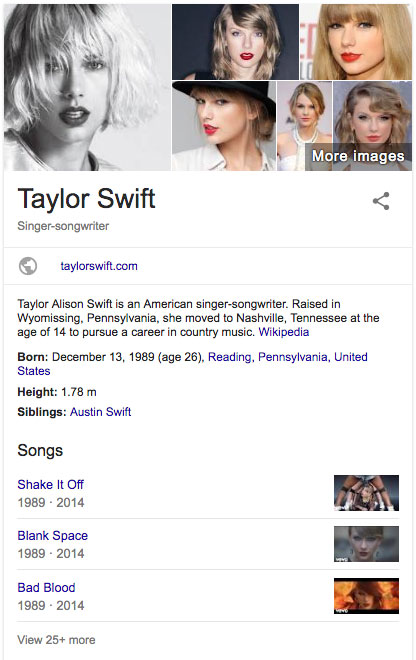
    Taylor Swift Knowledge Graph

    Social media and SEO is a bit of a murky subject. Google has explicitly stated that social factors, like Facebook likes and Twitter followers, don't play a role as ranking signals. So no matter how popular you get on social media, unfortunately, it won't lead directly to higher search rankings, and links from your social media profiles back to your site won't pass link juice. There are ways, however, that social media will impact on your SEO efforts.

    1. Search engines crawl social media pages. As we mentioned previously, posting links to your page on Facebook, Twitter, YouTube and other social media sites is a way to get spiders to find, crawl and index your new website. If you've got a Pinterest account, include your URL in the descriptions of your pins.

    2. Search engines index social media pages. If you search for WooRank, our Twitter and LinkedIn pages show up third and fourth in the results.
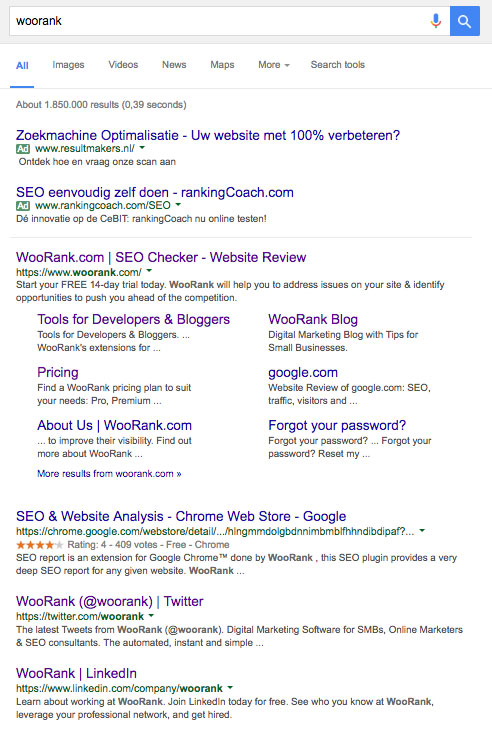
    WooRank social media pages in SERP

    This is important because it helps keep users within your ecosystem, allowing you to move them through the conversion funnel.

    3. Google has integrated Twitter feeds into its SERPs. It now displays Tweets in a carousel in its search results for branded keywords. This is true for both people and companies. They're served just below the news results, right at the top of the page. Like the Knowledge Graph, your tweets will allow you to jump to the top of the page for branded keywords.

    4. Other search engines use social authority as a ranking signal. Just because Google doesn't take social signals into account when determining ranking doesn't mean it's the same rule used by everyone. In fact, back in 2010 Bing told Danny Sullivan at Search Engine Land that they do, in fact, determine the social authority of a user and use that to influence search results.

    Yes, "search engine" is often just another word for Google when talking about SEO, but spending a little time on your social media presence to boost your rankings in the world's second largest search engine will help you in the long run. Plus, you never know when Google will start to use social signals for rankings.

    Document Sharing

    If you've got documents that Google can't easily crawl, like a PowerPoint slideshow or a PDF, consider posting it to a document sharing site like SlideShare. Approach this content like you would any other content that you'd publish on your site: Start with keyword research to decide which you want to target and then optimize on page elements for those keywords. These elements include:

  • Filename: Use a keyword-rich filename for your presentation and follow best practices such as using only lowercase letters and avoiding underscores between words.
  • Title tags: Optimize your SlideShare title tags as you would for SEO. Make it between 50-60 characters long and include your relevant keyword.
  • Meta description: Again, follow SEO practices for your descriptions — keep it under 155 characters, include your keywords, make it specific and include action-oriented language. Note that SlideShare gives you way more than the recommended description length, so count your characters.
  • Transcripts: Search engines can't crawl slideshows, so they won't find any keywords you use in the text. However, SlideShare transcribes your slideshow and puts it on the page, so make your presentation keyword rich.
  • Using effective calls to action that point back to your site will then allow you to take advantage of SlideShare's ranking power. Links to your site may be nofollow, in which case you won't get link juice, but you'll still get your content to rank at the top of search results, earning it a huge audience. You can then use calls to action to get users to your landing pages and convert them there.

    Citations are listings of your business' name and address on external web pages, normally a local business directory like a chamber of commerce or community group website. Make sure your NAP is consistent across all local citations, since consistent and correct NAP information is the most important local ranking signal. Conversely, incorrect or inconsistent NAP is the strongest negative ranking factor. Spending time making sure all your listings are correct is a tedious process, but it's very important.

    Web directories used to be a common practice for SEOs looking to generate some easy backlinks. Unfortunately, this resulted in a lot of low quality, spammy directories that provided little to no value to users. However, if you submit your URL to quality directories like Best of the Web or Alltop, you'll make it easier for search engines to find and crawl your pages.

    While reviews are most often discussed as a part of local SEO, they're an important element of off page SEO for any business. Positive business reviews instill positive brand awareness and trust, act as a citation for your business and help in conversion. In fact, 80% of customers trust online reviews as much as a personal recommendation (although they are concerned about fake reviews). Like with document sharing sites, putting your business on highly ranked review sites like Yelp will help get your name at the top of search rankings for keywords you would normally not necessarily compete or optimize for.

    Sometimes called blog marketing or forum marketing, leaving comments on blogs, forums and question-and-answer sites is another old school SEO trick that, while not as effective as it once was, can still be used to your benefit. Most forums and blog comment sections automatically make all links nofollow links, but that doesn't mean they don't have any value. If you're participating in a discussion in a way that adds value or answers a question, you'll build your reputation as someone knowledgeable in your niche. Plus, if you're sticking to high-quality blogs and forums, Google will learn to associate your business with the right type of neighborhood which helps build up trust and authority.

    Conclusion

    So there you go: four off page SEO tactics that help you increase your rank and exposure without creating a single link. And the best part is that all of the elements we talked about are completely under your control, so there's no need for buttering up bloggers or in-depth outreach campaigns. And even better, since off page SEO is as much about developing brand exposure, awareness and reputation, not only will you get more traffic, you should also see more qualified traffic as well.

    What off page SEO tactics do you use to build brand awareness and manage your online reputation? What's worked? What challenges have you encountered?


    Source: Off Page SEO: Beyond Link Building

    The Number One #SEO Secret to Getting a High #Ranking in #Google

    The Number One SEO Secret to Getting a High Ranking in Google For those of you who didn't make my session at #BlogHer16, I ran a Geek Lab on how to build an online business. I started my first business when I was 14 years old. I created a website and got it to the top of Google, monetizing it with Google ads and ... read moreAll in One Plus (AIO+) WordPress Plugin Is Now Becoming Google's New Best Friend All in One WordPress Plugin presents the phenomenal secret to churn out the best ranking blogs ... the consumer will get Surefire WP SEO which is an 8 part video course showing the steps to rank among the top 10 of Google's list. The other bonuses ... read more

    The State of Local SEO & Where to Focus Now If there's one thing ... You can't get to your destination if you don't know where you're going. If you're promoting a hotel, for instance, your primary goal is probably to get more reservations — local SEO for you will mean ranking high in Google's ... read moreHacking SEO: The Fastest Way To Double Your Rankings In 90 Days This story starts about a month ago when Vasil Azarov with Startup Socials challenged me to create an actionable SEO webinar that could improve brand's organic Google ... re ranking high, it's possible to stay there for quite some time. SEO is one ... read moreA Beginner's Guide to SEO But by far, the acronym most people ask about is SEO or ... a part in how Google chooses which results to show you for a given search. Here's how Searchmetrics explains it in its ranking factors study: Well positioned URLs have a high number of likes ... read moreMastering SEO: The Complete Guide to LSI Keywords With these two important SEO updates, Google ... 10 highest ranking web pages The number of times each of the keywords are mentioned on the top 10 highest ranking web pages "LSI" and "keyword" are present on each of these high-ranking pages. read moreMastering The Art Of Local SEO To Rank Your Local Business If you own a local business or are managing the online marketing for one ... getting a higher ranking and improve your local SEO. Additionally, the quantity of domains that link to you will also play a role in your local SEO. If you're getting high ... read moreYour Guide to Keyword Research for SEO Google has the AdWords Keyword Planner, while Bing has a keyword research tool in its Webmaster Tools. Both are technically designed for PPC keyword research, but they are both really useful for SEO. Use Keyword Planner's adgroup ideas to get a list of ... read moreThe power of SEO in a package you can afford Many people still get confused between what is non-paid search and what is paid search. Without any doubt, Google ... one and you will strike gold in achieving high visibility in terms of traffic to your website and of search listing. How is the pricing of ... read moreSmall business hit in the pocketbook by Google Keyword Planner changes Google no longer lets you know the number of people looking for service stations and washing equipment separately. Higher costs for small business Eren McKay, a Brazil based SEO expert ... it will end up getting traction and many times ranking in the ... read more

    Buy AutoTrafficRSS script now for $27 only!

    We will send the script to your PayPal email within few hours,Please add FullContentRSS@gmail.com to your email contact.
    Source: The Number One #SEO Secret to Getting a High #Ranking in #Google

    Monday, August 22, 2016

    How long does it takes to increase in SERP for new site After Backlinks index?

    Hi friendsFriends i am new to seo please guide me i have a new website crack softwares download site just one month old sitei just created backlinks to my new money site friends please check my strategy is it going right or not ?

    Web 2.0 Properties ( 10 unique articles links 10 unique domains )Angela Forum Profile Links ( 20 links)EDU AND GOV ( 5 links )HIGH PR PROFILES ( 20 links )SOCIAL MEDIA PROFILES ( 5 links )BLOG COMMENT ( 10 links )DOC SHARE ( 5 links )

    i created these backlinks in 15 days time all backlinks pointing to my home page with different 7 keywords niche related and naked links mix ........now i am waiting for backlinks indexing so i want to know for new website when backlinks index after how many days backlinks effects starts showing and my serps increase in google ????????? friends please reply me thanks


    Source: How long does it takes to increase in SERP for new site After Backlinks index?

    SEJ Wrap-Up: SEJ’s Complete Guide to #Google Panda, Penguin & Hummingbird

    SEJ Wrap-Up: SEJ's Complete Guide to Google Panda, Penguin & Hummingbird | Latest News

    Buy AutoTrafficRSS script now for $27 only!

    We will send the script to your PayPal email within few hours,Please add FullContentRSS@gmail.com to your email contact.
    Source: SEJ Wrap-Up: SEJ's Complete Guide to #Google Panda, Penguin & Hummingbird

    Sunday, August 21, 2016

    #Google Questions & Unofficial Answers: “Does #Google Make Junk Solicitation Phone Calls?”

    Google Questions & Unofficial Answers: "Does Google Make Junk Solicitation Phone Calls?" | Latest News

    Buy AutoTrafficRSS script now for $27 only!

    We will send the script to your PayPal email within few hours,Please add FullContentRSS@gmail.com to your email contact.
    Source: #Google Questions & Unofficial Answers: "Does #Google Make Junk Solicitation Phone Calls?"

    Saturday, August 20, 2016

    How to Jumpstart Your Hotel’s Direct Bookings Through SEO – By Steven Briley

    How to Jumpstart Your Hotel's Direct Bookings Through SEO – By Steven Briley August 19, 2016 Share Tweet Pin Mail

    In hospitality marketing, the digital landscape is constantly evolving and the travel consumer journey to a direct booking is becoming more and more complex. To help you better navigate the digital landscape and shift share to the direct online channel, HeBS Digital's  "Jumpstart Direct Bookings" Series shares industry best practices to boost direct bookings through the top revenue-generating marketing channels. From SEO to Multichannel Campaigns, you'll learn insider strategies and concrete action steps to start shifting share from the OTAs today.

    The first best practices action plan in our series is "Jumpstart Direct Bookings through SEO."  Read on to learn crucial strategies you may be missing. 

    Tablet with google search page on screenAs most marketers are aware, change is constant when it comes to search engine optimization. Smart hoteliers must adopt a proactive and holistic approach to content creation, marketing and optimization in order to make the greatest impact on the SEO landscape.

    With more than a third of hotel website revenue generated as a result of organic search engine referrals, SEO continues to be an integral piece to hotel digital marketing. With major search engines like Google changing their algorithms more than 500 times a year, as well as introducing new features and functionality that impact how search results appear on the Search Engine Results Page (SERP), hoteliers must be as vigilant as ever in how they implement and adapt SEO strategies over the course of time.

    Hotel marketers must make data-driven decisions derived from careful analysis of measurable results and research. Industry best practices may evolve over time, and smart digital marketers must consider SEO as an ongoing effort grounded in hard data, but susceptible to volatility, and adjust their efforts accordingly.

    1. Create hospitality-specific content to drive conversions.

    San Lucas Resort Goofgle screenshotDifferent from common commodity trading sites, hotel websites require unique approaches to on-page copy, tailored content marketing strategies, and hospitality specific SEO. Successful hotel websites not only inform, but inspire, the travel planner, highlighting unique value propositions of the specific property and destination. Engaging content that is tailored to attract a specific set of conversion-ready and qualified consumers throughout the various stages of the purchase funnel.

    Informative, high-quality content directly leads to more immersive user engagement, resulting in longer time on pages, more pages visited and lower bounce rate. All of these metrics send positive signals to the search engines, which utilize the information in determining where a page ranks on the SERP.

    2. Inform your content strategy with user insights and traffic metrics.

    With high quality content in place, it is time to keep track of rankings visibility, user engagement insights and organic traffic to monitor the impact of the content and see how it is being rewarded by search engines and end consumers.

    Screenshot - performance trackingAdopt a proactive approach to performance tracking via an array of analytics tools:

  • Drive content creation and optimization decisions with consistent monitoring of keyword ranking visibility on a platform such as BrightEdge.
  • Stay current on organic traffic and user engagement trends by consulting industry-leading analytics platform like Adobe Analytics.
  • Conduct technical SEO spot checks and assessments using Google Search Console and Bing Webmaster Tools.
  • Perform regular, ongoing inbound link profile assessments using a fresh web explorer such as Moz Open Site Explorer. 
  • 3. Implement a proactive, ongoing SEO strategy for content recommendations and updates.

    With robust, highly engaging content in place, and an eye on key reporting and analytics tools, digital marketers must be prepared to commit to an ongoing and proactive approach in order to drive direct bookings. The focus of these efforts should remain on the creation and optimization of high-quality content.

    In addition to a commitment to engaging content, SEO efforts must prioritize quick and effective responses to shifts in search engine algorithms, user search demands and the competitive landscape.  Monthly reporting and action steps, weekly data-gathering and ongoing optimization efforts are all keystones to maintaining a healthy, effective strategy to maintain and increase organic traffic, conversions and revenue.

    4. Utilize an industry-leading search visibility platform.

    Utilizing a robust performance and search visibility platform is essential to effective, ongoing SEO efforts. BrightEdge is one such platform, operating as a multi-faceted SEO analysis tool centered on tracking the organic search performance of digital content. The platform allows marketers to quickly and easily identify high-performing pages, search visibility opportunities, recent successes, top engagement and traffic sources, and in-depth performance analysis against a set, but adjustable, group of competitors.

    With streamlined information available, marketers can make informed content recommendations and optimization strategy suggestions. Ultimately, with the availability of data on high-value keyword terms and tracked performance over time, it's possible for marketers to improve visibility, traffic and revenue via organic search with the implementation of data-driven strategies.

    5. Ensure content is mobile friendly.

    Each year sees mobile search take up a greater share of overall search activity, now accounting for over 30% of website visits. Remaining aware of the latest developments in mobile search, as well as keeping an eye on the level of engagement and where in the purchase funnel mobile visitors are will allow hotel marketers to adapt a strong mobile content strategy to increase visits, bookings and revenue via the mobile search channel. 

    Screenshot Mobile friendly test

    6. Secure and optimize key local listing citations.

    A uniform local search presence is one of the most critical components of a holistic and effective SEO strategy. Eliminating any inconsistencies within a hotel's local search presence, reducing duplicate listings within directories, and maintaining streamlined and optimized local search information is key to success in local search.

    Google screenshot for the Resort at PedregalBy simply ensuring local search citations are uniform, streamlined and optimized, hotel marketers satisfy a key piece to ranking algorithms across search engines. In short, search engines place greater trust in uniform listings across well-established portals and are more likely to prominently position a hotel on the SERP as a result. Local search optimization efforts should include quick verification and routine maintenance of local profiles across a variety of listing platforms, including services like Google My Business, Yelp, Bing, CitySearch, Superpages, Yellow Pages and many more.

    Maintaining a uniform local search presence is one of the most important components of a comprehensive SEO strategy for hoteliers. A high priority in 2016 should be correcting any inconsistencies within the hotel's local search presence, reducing duplicate directory listings, and ensuring streamlined and optimized local search information.

    7. Utilize a proactive and defensive link management strategy.

    Search engines learn about specific pages and whole sites by analyzing links from other sites that lead to the page or domain in questions. Links from sources the search engines deem as trustworthy and high-value, like .edu, .gov, or prominent editorial sites to name a few, signify to the search engine that the linked page or site is also trustworthy and therefore worthy of prominent placing in search results. Alternatively, links from non-trustworthy or spammy sources result in search engines detracting from a site's overall visibility.

    In order to gain credibility from links and avoid punishment for bad links, it is crucial to monitor all inbound link activity and opportunities. Performing regular inbound link audits allows hotel marketers to view the quality of their existing links, disavow any negative links, and find opportunities to seek out new, high-quality links. 

    8. Utilize a strong content management system (CMS) to make real-time content and technical SEO updates.

    A content management system (CMS) can be a revelation or a disaster. Ideally, a CMS should offer the ability to make updates to on-page content, metadata, images, promotional tiles and other critical site components with ease and in real-time. Dedicated, trained personnel can easily make updates, implement new strategies, and ensure SEO best practices are being followed in a matter of minutes when utilizing a strong CMS. Contrarily, a poor CMS will frustrate and handcuff users, as well as sabotage the efforts of any well-intentioned marketers.

    9. Take a holistic approach to SEO, paid search, and digital marketing as a whole.

    Google screenshot for the Resort at PedregalOf course, SEO is just one element hotel marketers face when planning budgets, allocating their attention, and generally planning for success. While SEO is integral to the successful marketing of any hotel, and to driving direct bookings, a holistic approach that includes other digital marketing efforts, like paid search, banner advertising, email marketing, reservation retargeting and more, is crucial in turning a hotel website in a high revenue generator.

    10.  Go beyond generic hotel website copy to inform and entice the visitor.

    Basic hotel website information is the way of the past. Engaging and informative content of the area, nearby attractions, activities and other local knowledge lends the hotel an air of legitimacy, and signifies to travel planners that the hotel is a champion of the destination.

    Area guide content pages, interactive maps and calendars of events can all influence visitors to book on the site, and indicate to search engines that the site is worthy of prominent appearance on the SERP. Contrarily, boilerplate-style content featuring generic content does little to engage users, leading to poor metrics, and negative signals to the search engines.  


    About HeBS Digital

    Steven Briley is Senior Copy & SEO Specialist, Team Lead at HeBS Digital, the industry's leading digital technology, full-service hotel digital marketing, website design and direct online channel consulting firm based in New York City (www.HeBSDigital.com).

    HeBS Digital has pioneered many of the "best practices" in hotel digital marketing and website revenue optimization, as well as a range of industry-first digital technology applications.  The firm has won more than 350 prestigious industry awards for its digital marketing and website design services, including numerous Adrian Awards, Davey Awards, W3 Awards, WebAwards, Magellan Awards, Summit International Awards, Interactive Media Awards, and IAC Awards.

    A diverse client portfolio of top-tier major hotel brands, luxury and boutique hotel brands, resorts and casinos, hotel management companies, franchisees and independents, and CVBs are benefiting from HeBS Digital's direct online channel strategy and digital marketing expertise. Contact HeBS Digital's consultants at (212) 752-8186 or success@hebsdigital.com.

    previous post
    Source: How to Jumpstart Your Hotel's Direct Bookings Through SEO – By Steven Briley

    8 Steps to Master Localized #Keyword Research and International #SEO

    8 Steps to Master Localized Keyword Research and International SEO There is one often overlooked aspect of localization that many don't think about immediately as it pertains to international expansion: Localized Keyword Research and International SEO. This article will guide you through different aspects you need to ... read moreMastering The Art Of International SEO However, international SEO can result ... website in 8 languages in January 2012. By focusing on localized content and applying these steps, we were able to grow their organic traffic by more than 160%. The process involved: Keyword research within each ... read more

    10 Steps to Website Globalization Choose the content The content you publish for your international audience should be directed by the results of your market analysis and keyword research ... SEO professional in each country to give you the added advantage of insider knowledge. 8. read more45 free online classes you can take (and finish) by the end of the year This series of step-by-step ... re running a major international commercial website or managing a personal blog. At the end of this course, some of the skills you'll have mastered include knowing how to see how well your paid keywords perform ... read moreSmart ways brands can save money on global marketing A final element in the planning process is to confirm the SEO needs for every market, producing content that is localised to offer the best return on investment (ROI). Regional keyword research ... international standard coding systems, such as UTF-8 ... read moreWeb Analytics Breakthrough! For some time I was under a nondisclosure agreement because they hadn't published their research, but all can now be revealed. Their solution is to do away with a single method and use a hierarchy of steps to ... complete with eight pages of mathematical ... read moreHerpesviruses in Abscesses and Cellulitis of Endodontic Origin We conclude that herpesviruses are present, but not required for development of acute apical abscesses and cellulitis of endodontic origin. Keywords ... Master Mix (Promega, Madison, WI) for VZV amplifications. PCR was conducted with an initial ... read moreVEGF-dependent tumor angiogenesis requires inverse and reciprocal regulation of VEGFR1 and VEGFR2 Correspondence: Professor JE Nör, Angiogenesis Research Laboratory, University of Michigan, 1011 N. University Room 2309, Ann Arbor, MI 48109-1078, USA. Tel: +734 936 9300; Fax: +734 936 1597; E-mail: jenor@umich.edu Vascular endothelial growth factor ... read moreCalifornia v. Texas in fight for the future Though Golden State voters approved Proposition 8 in 2008 to ban same-sex marriage, recent state polls show a growing majority favor of it. Texas remains gun country. California, meanwhile, not only has among the nation's most stringent gun laws ... read more

    Buy AutoTrafficRSS script now for $27 only!

    We will send the script to your PayPal email within few hours,Please add FullContentRSS@gmail.com to your email contact.
    Source: 8 Steps to Master Localized #Keyword Research and International #SEO